Healthcare science | Career Development and Education
From Ward Life to Hidden Science: How Amelia Found Her Place Behind the Scenes
There’s something quietly powerful about the people you don’t always see in a hospital.
The ones behind the scenes, analysing, testing, confirming, and guiding care in ways most patients will never witness.
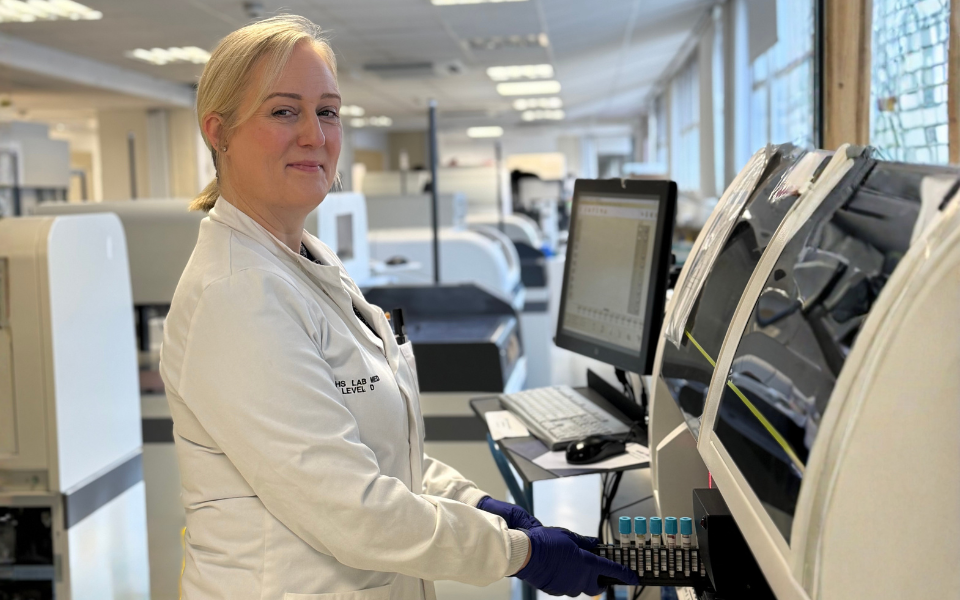
For Amelia, an Advanced Biomedical Scientist in Haematology at University Hospital Southampton (UHS), that unseen world is exactly where she belongs. But it wasn’t where she started.
Her journey didn’t follow the typical path. In fact, like so many NHS careers, it evolved through experience, curiosity, and the confidence to try something new.
Finding her footing: a first step on the ward
Like many people drawn to healthcare, Amelia always knew she wanted to work in a hospital, but not necessarily how.
After completing a science-based degree in biochemistry and pharmacology, she joined UHS as an auxiliary nurse (now known as a Healthcare Support Worker) on an orthopaedic ward, gaining first-hand experience of patient care and hospital life.
“It was a really good insight into hospital life,” she reflects. “You get to see how everything works and how important every role is.”
That early experience offered clarity. While Amelia valued the patient-facing side of care, she found herself drawn back to the scientific environment she had studied. Stating “I realised I preferred going back to the science route… working in the lab still supports patients, just in a different way.”
That shift in direction became the turning point, leading her toward a trainee Medical Laboratory Scientific Officer (MLSO) role in haematology, and the beginning of her career in biomedical science.
A different route into biomedical science
Not every journey into biomedical science is straightforward, and Amelia’s is a great example of that.
Although she already had a science degree, it wasn’t HCPC-approved, meaning she needed additional training to qualify professionally.
“It was a bit of a challenge because it took longer,” she says. “I had to complete a Masters alongside my training, so I stayed in a trainee role for longer than others.”
But with support from UHS, including funded study and day release for university. She was able to complete her MSc and gain registration. Looking back, that extra step became a strength rather than a setback. She said “It actually worked in my favour in the long run. Having that Masters early meant I was already prepared when it came to progressing into more senior roles.”
Her early career was rich with opportunity, from rotating across different areas of the lab to contributing to specialised work, including stem cell and bone marrow transplant processing. Developing a broader understanding of the service as a whole. It gave her something invaluable: perspective.
“You start to see how everything links together,” she says. “Even though you’re not patient-facing, you really understand the impact your work has.”
Stepping beyond the familiar
One of the defining moments in Amelia’s career came unexpectedly and when she stepped outside her comfort zone.
In 2003, she took on a secondment to the Falkland Islands, working in a small, multidisciplinary laboratory. It gave her a chance to do something completely different in a new environment and she embraced it.
“It just felt like the right time to go for it,” she says. “When do you ever get an opportunity like that?”
During her time in the Falklands, Amelia developed and broadened new skills across biochemistry and microbiology, working in a close-knit team, and experiencing healthcare in a very different environment. Stating, “It pushed me outside my comfort zone, but in a good way. You learn so much when you're in a smaller setup—you have to adapt.”
That willingness to step into new opportunities became a thread throughout her career. When she returned to UHS, she stepped into a Team Leader role, eventually progressing to become an Advanced Biomedical Scientist, specialising in haematology.
A role that keeps evolving
Sixteen years into her role, Amelia has seen just how much biomedical science has evolved. What began as a largely technical position has gradually expanded, bringing greater responsibility. Particularly around quality, governance, and supporting the wider team.
As she explains, “There’s definitely more responsibility now, A lot more focus on quality, governance and supporting the team.” reflecting how the role has grown beyond the bench.
Today, her work blends scientific expertise with leadership. Alongside her specialist focus in haematology, she plays an active role in mentoring colleagues, overseeing processes and helping to maintain high standards across the service. While adapting to change hasn’t always been easy, it’s something she’s come to see as part of the role’s progression. “It can be challenging at times, especially when things change,” she admits, “but it’s also what keeps the job interesting. You’re always learning.”
That sense of growth hasn’t just come from the role itself, but from the environment around her. Amelia highlights the importance of team support at UHS, especially during busy or demanding periods. “We’ve got a really supportive team, and that makes a big difference. You need that when things get tough.”
Away from the lab, flexible working has also played an important role in sustaining her career. Being able to adapt to her working pattern has allowed her to balance professional growth with family life, something she sees as essential over the long term.
“It’s been really important for me,” she reflects. “It’s meant I can continue doing the job I love while managing life outside of work.”
Making the invisible visible: Harvey’s Lab Tours
While much of Amelia’s work happens out of sight, one part of her role brings it directly into focus.
Through Harvey’s Lab Tours, she helps young patients and their families see what happens to their blood samples. Turning something unfamiliar into something understandable, and far less daunting. It’s also one of the rare moments where she gets to step out from behind the lab bench and connect directly with the people her work supports. “It’s one of the few times we actually get to meet patients,” she says. “And that connection is really special.”
The tours are designed to break down complex processes into something accessible and interactive. Patients can follow their sample’s journey, see it under a microscope, and begin to understand the role laboratory science plays in their care by explaining the journey from test to diagnosis.
For many children, especially those who feel anxious about blood tests, it can be transformative. Amelia often sees how uncertainty turns into curiosity once they see things for themselves ,“They often feel nervous because they don’t know what’s happening,” Amelia explains. “Once they see it, it makes much more sense—and that can really help put them at ease.”
Sometimes, the impact goes further than expected. Amelia recalls how one young visitor was inspired enough to pursue the same career path, admitting, “We’ve even had someone come on a tour who was inspired to become a biomedical scientist—and now they work with us. That’s amazing to see.” For her, this part of her work stands out as a real highlight and rewarding aspect,“I’m really proud to be part of it. It’s such a positive thing to offer.”
Reflections and advice: carving your own path
Looking back on her career, Amelia is clear on one thing, there’s no single route into biomedical science.
Her own journey, from the ward to the laboratory, is proof that careers don’t need to follow a straight line. What matters most is being open to opportunities and willing to keep moving forward, even when things take longer than expected.
As she puts it, “it doesn’t always matter if your path isn’t straightforward, you just need to be willing to keep going.”
That said, she encourages those considering the profession to take the time to research their options, especially when choosing a degree. Understanding whether a course is HCPC-approved can make the process more direct, though she’s quick to reassure that alternative routes still exist. “It’s not the end of the world if it’s not approved. You can do top-ups… it just might take a bit longer,” she explains.
However, things have changed slightly in recent years. While there are still ways to build on a non-HCPC approved degree through IBMS-assessed top-up modules, a Masters is no longer used as a route to ‘top up’. Because of that, starting with an IBMS-accredited and HCPC-approved degree is often the most straightforward path. Locally, universities such as Portsmouth and Westminster offer these courses, and we’re able to support students with third-year placements in our lab. (As routes and requirements can change over time, it’s always worth checking out the latest guidance and doing your own research before applying.)
For those still unsure, Amelia highlights the value of gaining experience within the NHS. Whether through support roles or entry-level positions, to better understand where your interests lie.
After nearly 30 years at UHS, it’s not a single milestone that defines her career, but the journey as a whole. There have been challenges along the way, but also opportunities to grow, adapt, and keep learning. “It hasn’t always been easy,” she reflects, “but I’ve kept going, and I’ve had some great opportunities along the way.”
And while much of her work takes place behind the scenes, Amelia is confident in the impact it makes.
“We might not always see the patient,” she says, “but we know the difference we’re making.”
Amelia’s journey is a reminder that careers in healthcare don’t always follow a straight path, and that’s often where the most growth happens. From starting on the ward to developing a specialist career in the lab, her story shows how opportunities, support and determination can shape a career over time.
Whether you’re just beginning to explore healthcare science, considering your options, or looking for your next step, there’s no single way in, just a willingness to start.
To explore your options and discover where a career at UHS could take you, click here.
Related Blogs
From Clinical Expertise to Service Innovation: Natalia's Specialist Doctor Career Journey
More
The Career She Always Wanted, Just Not the Way She Expected: Kim's HCSW Career Journey
More
Meet the Pharmacists Shaping the Future of Healthcare at UHS
More